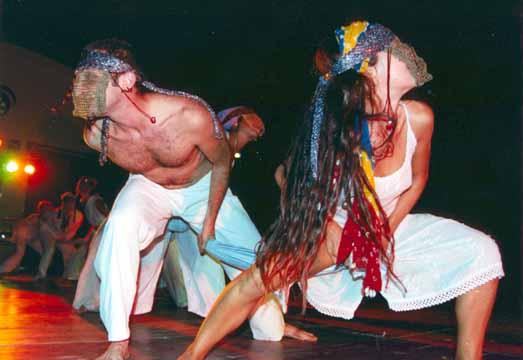
Siddhartha
the smile of the river
written by Gary Brackett
Prologue When the audience enters the actors are in their seats, to form a thousand-petalled lotus. As soon as the public is ready for the lights fade. Log
the boatman with a lantern. She explores the space, moving, illuminating the lantern with the different parts of the scenery and the public.
Boatman:
The man would have made his great discoveries if you were sitting alone, if he had not walked alone? From
peaks and isolated lands were the answers.
directly to the public:
And the river is watching us, with its thousand eyes, green, white, crystalline, blue as the sky. Affectionately watch the flowing of water, in his clear green, clear lines of his plan full of secrets. Read pearls are seen rising from the deep, quiet bubbles float to the surface and the blue sky is reflected. Slowly
actors, singing softly, beginning to open up a long piece of cloth, as they move toward the runway.
Chorus (single item; action: the river)
Voice:
Here I see the point in the middle of everything, of all things.
All:
I am the meaning. The meaning of everything.
Voice:
The four cardinal points meet in me. I am the center.
All:
It all flows from me, come back to me.
Voice:
I am what they call the great mystery.
All:
I am what everybody calls the law is not revealed.
Voice:
I am here and so I know. Here I know everything.
All:
Now I know myself.
Voice:
I am the truth and will.
All:
And nothing exists beyond my control.
Voice:
I am the pride and joy.
All:
Nothing exists on top of my joy.
Voice:
I own my life.
All:
And I will lead my life right.
Voice:
I'm here in light of my presence.
All:
And I am aware of my power.
Voice:
I am the reason.
All:
Nothing exists on top of my determination.
Voice:
I am the truth. I live in spirit.
All:
So I will live for eternity.
Voice:
I am the unity of everything.
All:
And whatever happens,
happens in me.
I am the River. I own the land.
Boatman:
I do not have anything. Nothing is mine, I know nothing, nothing I have learned. How strange is this! Now, they are no longer young, that my hair is fast becoming gray, that my strength begins to diminish, now I'm still starting off as a child.
Choir as the river (development of action: the coming and going):
Things are going backwards.
Fluendo continuously back
singing joyfully.
not the shadow of the past,
not the shadow of the future.
Boatman:
River has many voices. It does not have the voice of a:
Chorus:
of a king of a warrior of a bull
a nocturnal bird of a woman giving birth to a
to groan again and a thousand other voices?
Siddhartha (pulling the fabric of the river that disappears quickly):
Smoke. Fuimus prima.
The choir, transformed, singing softly:
Sometimes I Feel Like a Motherless Child .... a long, long way from home.
Scene 2 at the River Boatman
:
Wake up, young shade, but in the darkness. Wake up, appearance, oh inside of us. Find, find your way. Go to the wall of light. Appearance, appearance, who is the appearance? Oh sweet smile. Here, oh here. The road is here. Forgot? The leaf, stone, wall light. Investigate the stone, the leaf, the stone, the hidden door, the River. Return, return.
Siddharta:
Our whole life goes up in smoke. There is no structure, no creative force, not even the smoky structure of our dreams. Come down more angel whispering in my ear. We're going up in smoke and now there's nothing left to pay them back just tired of the tedium of yesterday.
Choir turns in different Siddhartha.
Siddhartha (other items):
Nude e solitario sono venuto in esilio.
Nel suo ventre scuro non ho conosciuto il viso di mia madre.
Dalla prigione del suo corpo sono venuto nella prigione inesprimibile e incomunicabile di questa terra.
Oh perduto, nel labirinto caldo, perduto, fra le stelle brillanti su questa cenere esausta, opaca, perduto!
Senza voce sto ricordando, ho cercato il grande linguaggio dimenticato, il sentiero perso che conduce al cielo.
Suona nel mio cuore una musica solenne. Si riempie la terra, l’aria, l’universo;
Non è forte ma onnipresente, e parla a me di morte e tenebre.
E della marcia di tutti quelli che vivono, o che sono vissuti, e stanno converging on the plain.
The world is full of men who marched in silence: not a word is spoken, but in every heart there is a common knowledge.
The word that all men know and have forgotten, the lost key that opens the prison door, the path that leads to heaven.
Boatman:
Siddhartha fixed eyes staring into the water, he sees reflected his distorted face and spits on it. He turns a little to drop to bottom, to be submerged permanently. Sink, eyes closed, to their deaths.
OM The sound begins almost in silence and get up to a buzzing vibrant, strong.
Boatman:
When a man needs to know something, is a master.
Silence. A Siddhartha gets up and tries for himself the sound OM. Then the other one at a time until there is a chorus of OM.
Everybody Lay: Picture of sleep.
Scene 3, a dream, a dialogue
Action: a great divide, a crossing to meet themselves.
Boatman:
One way is open before you, that you are called.
Action: a great roar, the chorus against the river current.
Choir (other items):
Who are we?
Where we come from? Where
are we going?
The sense of all things is at the center.
I want to see my soul,
to see my birth.
I'm here in spirit and in this realm to see my soul.
I recognize some flaws.
I know my soul imperfect
like something I choose to improve.
you choose to improve your soul
but recognize the meaning of your choice?
And again .....
if I go in the center and discover the great mystery, then there is nothing mysterious about
exist.
And if I find out what really exists, then I will be
center and I'll be the reality.
Siddhartha, know thyself.
Know la tua anima
come la tua compagna costante.
Diventa la tua anima. In questo modo,
e solo in questo modo migliorerai.
Sento voci lontane e risate.
La mia mente si raccoglie in se stessa
dal naufragio di piccole cose.
Una luce brilla.
Il vento trema. Una stella lontana.
La notte, la luce. Una salmodia, una canzone,
il ballo lento delle piccole cose dentro di me.
Sopra tutti noi c’è qualcosa. Stella, notte, terra...... luce.
Oh perduto!.... Una pietra......
una foglia....una porta....oh apparizione!
Io, Siddharta, ti parlo.
Cerca di ascoltare: due, o due volte due;
la forza della vita conserva un equilibrio.
Heaven and earth, male and female, hot and cold
roots .... stem .... .... berry leaf,
south ... north, east, west .....
The force maintains a pace of life,
the rhythm of the heartbeat.
Each song, he
ya ya ya, he ya ya ya.
We'll not return.
We can never come.
But above all of us, above us all
there .... something.
And on the day the night.
But over the darkness .... what?
spiral
Recognize the way in which you move from one level to a higher level, a spiritual path
on which you evolve toward the total unit.
You live on land, a land with many, many
plans, and meet
greater spiritual infusion at every level.
The laurel, the lizard,
and the stone will never come again.
women weeping at the door
went away and never return. Oh
spring
the cruelest and most beautiful of seasons, you will
again.
The strange men are still buried,
like flowers and leaves, will still
,
and death and the dust will never come again,
because death and the dust will die.
Recognize your real parents:
sun and earth.
Expect your true inheritance
Inherit the whole. But even
command extraordinary beings in the sun or the moon change.
So I ask you: what things commanded
..... or change?
Choir, to the public: What things commanded
..... or change?
Scene 4, Samsara
Action: The serpent of Samsara, with Kamala
Boatman:
The world absorbs it, the pleasure, greed, sloth, and finally that vice which he had always despised and derided as the most foolish of all, greed.
Siddharta:
Oh I can not go now.
Chorus (whispering):
Why not?
Kamala:
Come through the hills, my love. Come back!
Boatman:
The ownership, possession, and the wealth they finally grabbed him, are no longer for him to play and trifles, but are now weight and chain. By a strange and subtle way is Siddhartha falls into the latter and most vile servitude, the dice game.
Siddharta:
Because his face is so white, and his face as wide and tall, with slicked back hair, blacks, and when she sits there on the bed looks like a girl. I can not go now.
Chorus: She is alone and
too.
Kamala:
Oh lost, and with the wind .... sad appearance, yet again, as I have known you in the timeless valley, where we will meet again on the bed of the spell in June.
there is a place where the sun shone in our hair, and the hill we could touch the stars with his finger.
Boatman:
Siddhartha begins to practice with increasing ferocity and passion the game in money and jewelry. In no other way he may prove more openly and more loftily his contempt of wealth, the idol of the merchants.
Siddharta:
And when she contracted her mouth and looks so serious and thoughtful, she è come una fanciulla.
Coro:
Tu sei solo adesso. Tu devi fuggire, o morirai.
Kamala:
Qual’è il giorno che si scioglierà in un ricco clamore? Qual’è la musica dei nostri corpi....
Barcaiolo:
Egli ama quell’ansia e cerca sempre di rinnovarla, sempre di intensificarla, di stimolarla sempre più acutamente. E dopo ogni perdita ingente egli anela a nuove ricchezze, si rituffa energicamente nel commercio, vuole continuare a dissipare, vuole continuare a dimostrare il suo disprezzo per la ricchezza.
Siddharta:
Tutto questo è come la morte: lei condivide se stessa con me, dormo nel suo letto....lei è il valore e il senso della mia vita. Tutto questo è finito adesso, e ogni volta è come la morte.
Coro:
E come la vita....ogni volta che muori, rinascerai ancora. E morirai cento volte prima di diventare un uomo.
Kamala:
Leste sono le bocche della terra, veloci sono i denti che nutrono il nostro amore. Noi che siamo stati creati per la musica, non sentiremo più la musica. Nelle nostre case scure i venti sono silenziosi.
Barcaiolo:
Siddharta non è più indifferente verso le perdite, perde la pazienza verso i pagatori morosi, perde il gusto di donare e prestare il denaro ai supplicanti. E di night sometimes dreams of his money.
Siddharta:
I can not! I can not! Not now .... later, more slowly.
Chorus:
No. Now.
Kamala:
Appearance, appearance, back, back in life but not in magic, where we have never died, in the enchanted forest, where we are still lying on the ground, quiet.
Boatman:
And every time you awakened from this hateful spell, whenever he sees in the mirror in the bedroom his face aged and become more annoying, every time the shame and disgust the capture, he fled to again in the passion of wine, and then there, again, in the frenzy to gain and accumulate.
Siddharta:
I'm afraid. I have no place to go.
Chorus:
You have to find the place.
Kamala:
Come over the hills, oh my love back.
Boatman: Then
a dream makes him remember ..... how close the voluptuousness of death. His heart is full of misery and secret fears.
Siddharta:
'm lost.
Chorus:
You must find yourself.
Kamala:
Oh lost, and with the wind .... sad appearance yet again.
Boatman:
Kamala takes in a golden cage, a small and rare songbird.
Siddhartha: I'm just
: Where are you?
Chorus:
You have to find me.
Kamala:
We must try to love one Grim.
Boatman:
only lies, and poor, as a castaway on the beach .... in a garden of delights. Samsara has named this game.
Siddharta:
This terrible and wonderful phrase, the last absolute wisdom that the world can give, only remember the end, too late and it is said, wearily.
Chorus:
It stays there, terrible and unworkable, the dusty chaos of our lives. Do not forget, not forgive, not to deny, not explain, not hate.
Kamala: Oh
perishable and mortal love, which are born and die with this body for this brain, your memory will inhabit the earth forever.
Scene 5, the rite of the river and the five senses and the breath.
Chorus:
Life has become shadow. The lights
lives again become shadows.
gives life a shape:
for here? Why?
why now? Why then?
Everything I have touched and who touched me, this dance
allusion to this.
Boatman:
Play, slight rises on the river by the many voices singing.
hear? Play better!
and all entries as a:
moans of desire and rice paper,
angry shouts and groans of the dying,
everything is blended and braided
all voices, all goals,
all desires, all the pain , all the joy,
all the good and the bad .... the world's music,
of life.
Chorus:
continually flowing, flowing, but always
here, only here.
Always the same at any time again.
loves this river, stay with him, learn from it.
everywhere the same,
beginning or end,
source or mouth,
mountains or ocean.
not the shadow of the past,
not the shadow of the future.
Boatman:
You can learn from him but not me.
To hear the river has taught me.
First of all I learned from him to listen,
to turn the ear with tranquil mind,
with an open heart, waiting,
without passion, without desire,
without judging, without opinions.
Chorus: Voice of the River
sorry,
way of burning desire,
sad song and coveted.
Fluendo towards its goal,
not the shadow of the past, not the shadow of
this dance allusion to this.
Boatman:
You have learned the secret of the river?
Time does not exist.
I saw my life and even that is a river:
the boy, the mature man, the old ....
only separated by shadows, but nothing real.
Nothing was, nothing will, everything is present.
Is not it time the substance of all pain?
all difficulties and evil, all is misery and fear?
Come, won the time .... listen:
the song of the ten thousand voices, all living creatures.
know it? Action
simple breathing and movement that involves the audience.
Scene 6, passion, a means of conversion
Boatman:
still Oh, and there seems to be something that touches me with mystic
radiation, such as whales
of forgotten dreams ....
Chorus:
At each step of the way Siddhartha
learn something new,
as the world turns his heart sick.
see the sun rise over the wooded mountains and
setting beyond the distant beaches populated with palm trees.
Boatman:
something immediately, something here;
something done, I do not know where;
that no language can state it.
Chorus:
At night see the stars in the sky ordered,
and
crescent moon floating like a ship in the blue.
see trees, stars, animals,
clouds, rainbows, rocks, herbs,
Boatman:
Have you ever felt the feeling that your soul is real
imperceptible to your mental vision, except in some
sacred moments?
Chorus:
flowers, streams and rivers;
see the gleam in the bushes in the morning dew.
This has always existed in its many colorful aspects.
Boatman:
E ¢ as if the opposites of the world,
whose contradictions and conflicts
give rise to all our problems and concerns
,
were melted into unity.
Chorus:
But in the past this had not been for Siddhartha,
because the reality was beyond the visible things.
But now his eye is freed to linger here,
sees and recognizes the visible,
look for his country in this world.
Boatman:
think the spirit as something bright
hovering over the body until death
,
when this light fades slowly.
Chorus:
Short are the days, short nights, every hour
fly away as fast
sail on the sea full of joy.
He sees a nation of agitated monkeys in the forest;
heard their wild cries.
Boatman:
Treat your hands as a precious commodity
and hands
the eyes and mouth and ears.
Chorus:
Siddhartha sees a ram chasing a sheep
and join with her.
In a swamp pike sees the drive, passion and relentless
energy emanating from the circles that the impetuous rush
hunter track in the water.
Boatman:
Have a wonderful use of such property, whether
Each himself as something sacred,
as a power to truth.
Chorus:
This has always been and he had never seen;
did not participate.
But yes, participates and belongs to you.
Boatman:
All symbols ....
exist as that which conceals the truth.
Chorus:
light and shadow across her vision,
the stars and moon through the heart, Belle
one and the other things, the feeling and thoughts,
behind which lurks the ultimate meaning.
Boatman:
long as a man does not understand a word used
:
mystery.
Chorus: A
should extend both listening
both need exercise, both
should use to listen to the voices deeper ego.
of himself will have to experience hours.
Boatman: The real
monaco carries only the lyre.
Scene 7, in a sweet omen, the story of Kamala
Join a small group of servants; lead Kamala.
Kamala:
Why is there sex? from the beginning we did not understand exactly what it was. Brahma
We were shocked when we announced that our job was to begin a new way of creation.
Chorus: And
lui ha detto qualcosa sul corpo femminile.
Kamala:
Con grande naturalezza e gravità, abbiamo scoperto....e anche loro, gli dei hanno scoperto,....che cosa avremmo dovuto fare.
Brahma non aveva detto niente del piacere. Ci ha colto di sorpresa. Un giorno gli abbiamo chiesto:
Coro:
A che serve questo piacere?
Brahma:
Con un sorriso un pò imbarazzato, Brahma dice:
Per mantenere il lustro del mondo. Il piacere è Tapas dell’esteriorità.Il piacere è come un mantello che dobbiamo metterci addosso, altrimenti il mondo diventerà polveroso.
Se Tapas non ci avesse sempre tirato indietro verso il luogo senza forma dal which we came, the world would wither too soon!
Kamala:
would be good if you torment your wives, the king put their daughters in your beds, and even better, perhaps, that the Apsaras, celestial nymphs, were to deceive, to make fun of you ... .? Every time we give up, we help the world to revive its luster.
Choir, singing:
In his shady grove enter the beautiful Kamala,
the entrance to the grove is the brown Samana.
Deeply bows when she sees a lotus flower, with a smile
Kamala thanked.
more pleasant, thinks the young Samana, who sacrifice to the gods, is to sacrifice
alla bella Kamala.
Siddharta:
La sua vita si sta avvolgendo nell’oscurità del passato.
Siddharta dice a se stesso: così mi accosto a questa città sotto un dolce presagio.
Barcaiolo:
Il boschetto di Kamala, la famosa cortigiana.
Kamala:
Non sei tu che eri là fuori già ieri e che m’hai salutata?
Siddharta:
Certo ti ho già vista e ti ho salutata.
Kamala:
Ma non avevi la barba e i capelli lunghi e un vecchio abito stracciato da penitenza!
Siddharta:
Bene hai osservato. Tu hai visto Siddharta, il figlio del Brahmino, che ha abbandonato casa sua per diventare un Samana. Ma ora ho abbandonato quella strada, e la prima in cui mi sono imbattuto sei tu. Per dirti questo sono venuto, tu sei la prima donna a cui Siddharta parla altrimenti che con occhi bassi. Mai più voglio abbassare gli occhi quando una bella donna mi sta di fronte.
Barcaiolo:
Il movimento di milioni di sensazioni......la perdita o il guadagno di un momento, il volgersi del capo, il grande impulso senza scopo del Caso.... ha accresciuto il suo fiammante fervore.
Kamala:
E solo per dirmi questo Siddharta è venuto a me?
Siddharta:
Per dirti questo e per ringraziarti di essere così bella. E se non ti dispiace Kamala, I would ask you to be my friend and teacher, because I do not know nothing about art when you're a teacher.
Kamala (smiling):
Never happened to me that a Samana came to me from the woods to get to my school. Many young men come to me, even the children of Brahmins, but they are well dressed, well shod, a delicious perfume in her hair and a lot of money in his pocket. Did you take note?
Siddharta:
How should I not take note of what comes from such a mouth? But tell me, beautiful Kamala, you have really no fear of Samana in the woods? He could force you, beautiful girl. Could kidnap you. You might get hurt.
Kamala: This
that belongs to us on their own, we can only give it if we want when we want it. And so, just so it is with Kamala and the joys of love.
Love you can not extract.
They kiss.
Chorus:
Women, the attitude and stop the blood pure woman, the guardian of morality and embodiment of spiritual strength. Donna, real and humble and a defined path.
Siddharta:
Dear Kamala, then of advice: where should I go visit as soon as these things: clothes, nice shoes and a lot of money?
Kamala:
My dear, this is what many would like to know. You've got to in pratica ciò che hai imparato. Non c’è altro mezzo per un povero, di procurarsi denaro.
Siddharta:
Io so pensare. So aspettare. So digiunare.
Kamala:
Nient’altro.
Siddharta:
Niente. Però.....so anche comporre versi.
Kamala:
Un momento....Sai leggere? E scrivere?
Siddharta:
Certo. (al pubblico) Quando un uomo ha bisogno di conoscere qualcosa, un
maestro appare.
Coro:
......Una pietra, una foglia, una porta nascosta. E tutti i visi dimenticati.
Chi di noi ha conosciuto la propria sorella?
Those of us who watched in the heart of his mother?
Who among us is not always one and the stranger?
Boatman:
These images that burn in there without beginning or end, beyond the essential structure of the time.
Scene 8, father and son, the apex of the circle.
Boatman:
The world is like the impression that remains after the telling of a story.
Well ..... we are almost there at the beginning of our history .... ah .... I said the beginning? but .... the end, the beginning .... are all words, words are like gestures: there is only a certain number of gestures that someone can do, but the meanings are innumerevoli. Così le storie sono ripetute, con variazioni, e ogni volta possiamo scoprire in una lenta rotazione una nuova terra e un nuovo cielo di senso.......
come le storie di padri e figli.
Guarda, più avanti dove il fiume fa una curva, stanno arrivando, ecco è Siddharta e suo figlio, forse è Siddharta e suo padre, che confusione! Ascoltiamo adesso. Ascolta le voci del fiume....
Ci sono molti Siddharta, tutti in piedi esausti, con le braccia incrociate.
Padre (a Siddharta):
Così ho detto a lui, con il cuore pieno di rabbia, paura, ansia e tristezza:
che aspetti?
Coro (ogni volta che una voce parla il padre la segue):
are no joy to me.
Beloved by all, bring joy to all, yet do not bring joy in my heart.
Dreams and restless thoughts are brought to me by the river current.
Father:
You will be always like to wait until the day, noon and night?
Choir (every time a voice speaks the father continued)
My spirit is not satisfied.
My soul is not peaceful;
begin to feed in my discontent.
Father:
you tired Siddhartha. You'll fall asleep, you die. Then give up your connection?
Chorus:
I get tired, I do not go to sleep, I die.
Father (Passing him on the shoulder of each Siddhartha):
I can protect you from the need to live your own life?
Chorus:
Your children are not your children.
Father:
Who will protect you from Samsara?
tried to imitate, but you can not make them like you.
from sin, from greed, from foolishness?
You can love them, but not your thoughts.
It 's possible that my pity, my knowledge, my own anxiety research, protect him?
They do not come to you but through you.
But even if I died for he could lift ten times from the smallest particle of his destiny?
then who inhabit the house of tomorrow, that even in your dreams you can visit.
Father:
He 's gone into the forest and has become a Samana.
The choir comes out singing the song river.
Boatman:
Then the father realizes that no longer lives with him already in the house: Siddhartha has already abandoned.
Father (only on stage, as it is coming from the scene, speaking):
His soul lives in the house of the future, and even in my dreams I can visit.
Scene 9, the death of Kamala.
Enter a Siddhartha.
Behind the curtain, a silhouette: a vision of Kamala and Siddhartha in the Kamasutra.
item Kamala:
you the best lover I've ever seen. Someday when I'm older I want to have a child with you. But with all this love you're still a Samana, with all that you do not love me, you do not love any human creature. Is not it?
item Siddharta:
may well be the case. I am like you. Even you do not love, how else could you love an art? Maybe people like us can not love. They can ordinary men: this is their secret.
Siddharta:
Vasudeva! Hai sentito? Il fiume ride di me.
Barcaiolo:
Tu hai sentito ridere, ma non hai sentito tutto Siddharta. Ascoltiamo, udrai ancora altro.
Figlio di Siddharta (entrando):
Va a pigliartele tu stesso le tue fascine! io non sono il tuo servo. Sì, so che non mi batti, perchè non osi.
Lo so che tu mi vuoi continuamente rimproverare e umiliare con la tua bontà e con le tue premure. Tu vuoi che io diventi come te. Ma io, ascolta bene, io preferisco, proprio per farti dispetto, diventare un brigante e un assassino da strada, piuttosto di diventare come te! Ti odio, tu non sei mio padre, anche se fossi stato mille volte l’amante di mia madre.
Il figlio, corre fuori..... Siddharta lo segue. Lui si ferma quando vede il coro che entra.
Il coro entra, guidato dal Buddha. Portano sulle loro spalle Kamala che sta morendo. Lei è avvolta nella stoffa del fiume.
Coro, cantando:
Om è l’arco,
la saetta è l’anima,
bersaglio della saetta è Brahma,
da colpire con immobile certezza.
Loro continuano sottovoce:
il Barcaiolo scende per parlare a Siddharta. Tutti fanno capannello intorno a Kamala, stesa sulla postazione del Barcaiolo.
Barcaiolo:
Tu ti affliggi per ciò che non ci deve affliggere. I veri saggi mai piangono per i morti e neanche per i vivi.
Buddha
And Gautama said:
there was a time when I did not exist, nor you, nor these leaders, and none of us in the future will cease to exist. The origin of beings is unseen, the intermediate stage is visible, and their end is again invisible. In truth that which is born death is certain and what is dead birth is certain. So you should not grieve for the inevitable .... To Kamala .... for me .... or Vasudeva.
Buddha and the boatman began to unroll the fabric which is wrapped in Kamala. The choir returns to the starting position of the river (Prologue).
Music: Om rises as the river appears.
Boatman:
The river tends to the goal. Siddhartha saw him hurry, with the flow that has made him and his men and all that he has ever seen. He sees his father grieved for his son, he sees himself, alone and also bound by ties of nostalgia for her son away. All waves are rushing water goals, many goals, the waterfall, the sea, the ocean and all goals are achieved, and at each new destination follows. But the eager voice is unchanged. He feels it all together, all, and his injury is flourishing. Discard the flow
himself, full of sympathy and compassion, he is part of the unity of all things.
Choir (action of the river):
We are returning to the origin.
Listen carefully to the river;
The song of a thousand voices.
you would not listen nor pain nor the rice
Do not tie your soul to any of those items.
Every cloud, every bird, every beetle is still divine.
Perfect at any time by the brigand, the Buddha, the Brahman;
Listen to everything, all the units.
One way is open before you, that you are called.
All goals, all desires, all the pain, all the joy.
The big song of a thousand voices is in a word .....
When the sound reaches the peak river disappears.
Blind.
Epilogue
The Boatman takes the lantern and go back on stage. He discovered the choir in a position equal to that of the beginning of Scene two.
Boatman:
waiting for this moment, friends. Now it's coming, let me go. In the longer I waited for this hour long, I was the ferryman Vasudeva. This is enough. Farewell river, goodbye everyone!
The choir begins to move down the runway, as in scene two.
All return to their original position but with a new intention: contact and public involvement.
Chorus:
I will open my heart to the world
and breathe the breath of life
as river water.
Available in search of the sea.
And like the river that carries the waste
I polish the stones in my life.
I love but I can not seem to find a way to do so.
Although all show around the sacred cow
'm just a red wing out of my body
naked eye and the light that opens my mind. The determination
illuminates the path of my life I walk undaunted
the vast regions of thought and mind.
My journey begins with a magic mountain,
listening to the sounds of nature, I hear the birds, I feel my breath, I'm home.
At the same time up and down
everything and its opposite in a circle, slowly.
softly but intensely and then suddenly
breaks the life that reveals a God in every slice.
I'm not trying to find.
want to lose;
In this lake I try,
and I am sure it is an ocean.
The chorus after executing a series of actions Remain in tableaux. Slowly They Become aware of the public and begin moving down to Them.
Chorus, staring Deeply and Closely into the eyes of an audience member:
I want to be lost in this lake I seek
and I am un certain: it's the ocean.
Music fades out.
Silence.
Chorus, different voices, not altogether, to individual spectators:
What is the meaning of this; what is this all about?
Addressing the public the chorus announces the beginning of a tribunal of questions:
questions on the significance of the themes of the play for the contemporary world. Each chorus member expresses their own question.
Then the public is invited and encouraged to pose their own questions.
After some time the lights again fade and as in the opening moments of the play we see the actress who has portrayed the boatman on stage, again with her lantern, although she is no longer in costume. She is herself as in daily life.
She moves to the station of the boatman.
She speaks:
We have listened to the voice of the river; We have recalled with Siddhartha, our own lives and the way of our companions... a long or very brief time, as the case may be.
What is the meaning of this?
Seriously, or for fun, we will consult the wisdom of the East to better understand the mystery which leads our life.
The ancient Chinese book, The I Ching, or Book of Changes will propose an answer from the tossing of three coins...
No, I don’t want to play this attractive gambling...!
But though our will and blind impulse constructs this story we call Life, and gives it much flavour, nevertheless may something, or someone over us illumine our choices and direct us to a greater good.
Choosing one of the questions expressed she, or the audience member whose question she has chosen, tosses six times the coins, each time reporting the numbers.
The relevant hexagram is identified and she reads without comment the Judgement, Image, and significant Lines from the book. (Edition Richard Wilhelm).
The End
Principal sources:
Siddhartha. Herman Hesse. Transalation by Hilda Rosner
Hanto Yo. Saga of the Sioux, Ruth Beebe Hill
Look Homeward, Angel. Thomas Wolfe
Bhagavad Gita. Transalation by Swami Tapasyananda
The Prophet. Khalil Gibran
The Variety of Religious Experiences. William James
Ka. Roberto Calasso. Translation by Tim Parks


0 comments:
Post a Comment