 Julian Beck
Note: For those not familiar with the Living Theatre and its founders Julian Beck and Judith Malina then welcome to a new universe! Political theater, joy, liberation of theater, theater of the revolution, the Living was founded by the detachment of worldly Broadway, influencing generations of artists and activists, poets of the Beat Generation fifties until Jim Morrison, in this turbulent and wild Sixties, in the prisons of Brazil in the seventies, and still today in Europe, members of the Living continue to explore, challenge and define what it means being an artist.
Perhaps the test measure the influence of a person may be to consider how his ideas continue to inspire, to give an example of a path that others can follow. Not unlike the life and work of one person provides a measure of our own work: a reference point in the trial, the commitment and the chances of success. On 14 September 2005, twenty years after the death of Julian Beck's Living Theatre and yet continues. We the Living, like any other group or artist working today in the theater, poetry, cinema we always have a reference point, either a genius or a model of the complete artist. Not only is this a great challenge for the richness and breadth of his work, but personally I also feel some responsibility in trying to get to the level of his passion, his competence, his intellectual depth, its effectiveness as an artist and also as a human being. I have no doubt that he was one of the most important artists of the past century and if we add another extraordinary member of the Living, that is, Judith Malina, I am sure that the history of the combination of these two great forces will be studied in depth in this new century if no further. Fortunately for us she is still well in business (eighty!) And continues to create, always looking for the next show, the next form that carries out "the beautiful nonviolent anarchist revolution." Certainly a key element in this theater is wonderfully rich teamwork. Too often when we speak of Living there is a missing element and that element is not only the dialectic between Julian and Judith (stormy at times, so I'm told) but also, perhaps more importantly, the dialectic between those two dynamic energies and the company. The theater, most of the other arts, is a collaborative effort with the Living and you can not minimize the importance of the group: those events that led to the Living at its greatest notoriety can only be produced by stimulating the presence of an ensemble . Challenging because, as Judith explains, there una correlazione dinamica tra un movimento sociale e quello di una avanguardia di artisti politici: spesso il movimento segue gli artisti; un’altra volta sono gli artisti che hanno bisogno di raggiungere il movimento. E questo vale anche per il rapporto tra autorità vera e propria dei registi e il gruppo. E’ sufficiente dare un’occhiata a uno spettacolo come Paradise Now : dall’incredibile mole di energia e di sperimentazione della generazione degli anni Sessanta Judith e Julian trovarono ispirazione e a loro volta ispirarono quel grande movimento.
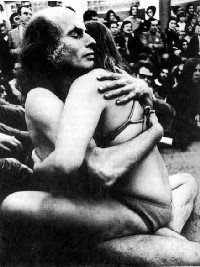 Paradise Now 1968
 We call it The Living Theatre of Third Street in Manhattan but in fact this is what has become. Not even four years after the death of Julian we have opened a 'storefront' (a former supermarket) in the East Village. A district involved in a fight between long-term residents, mostly poor and "colored" and the new phenomenon of 'gentrification' (the advance of concreting for the construction of new buildings, ndt. On this aspect of gentrification East Side of Manhattan see M. Maffi, in the mosaic of the city. Ethnic differences and new cultures in a neighborhood of New York Press, 1992, ndt) who tried to remove these poor families and the many artists who had for decades their home here. Thrown into the fray many homeless persons, activists of the movement for housing and various other political activists from the hard-line communists to anarchists and many social groups that supported the cause, all with a background of rock and roll clubs, bars, after -hours illegal drug users and pushers and the police chased them both, squatters, the Anonymous Narcotics Anonymous groups, poets, musicians, street gangs and criminal elements launch, Hare Krishna, fundamentalist Christians, students, punks, yuppies: this was the East Village and that was our audience. Most of the 'people who go to the theater' was too scared to venture to the East and South, where we were, and come see our work. More than one night there were more actors on stage and the audience! After pulling down the walls and the ceiling raised, with much excitement, we launched the new Living Theatre. The idea was to put new work on a rotating repertory. For nearly four years we created four new shows a year, many texts adapted by poets in direct cooperation with us. In addition, once a week we had our evening of poetry which were presented to people like Allen Ginsberg, Herbert Hunke and Taylor Mead, among other famous names, and many lesser known poets and 'Open Mic' and nights in which everyone could present their work. There were also jazz festival, readings of new texts, dance festival, outside groups with new productions, and many groups from the neighborhood with their events, parties, or meetings. Needless to say that there was always work until late at night with people who drank, took drugs, slept, made love, organizing, taking tests, talking, arguing. Much like social centers in Italy, the area of \u200b\u200bThird Street had something for everyone, but his attention was turned to political theater, and everything that was present had that taste of political event.
 Genoa GA, Resist Now (The Moloch Machine)
Non c’è spazio qui per elaborare la linea di sviluppo della forma del Living Theatre. Eppure forse le prime radici di un agire senza finzione trovano posto nel suo primo attivismo politico nelle strade di New York negli anni Cinquanta contro la bomba atomica, dove era presente in un senso elevato e si presentava nella strada come nella vita di tutti i giorni ma nella modalità teatrale della protesta. Così è stato nella Terza Strada, quando insieme con un gruppo di senza tetto da un ricovero locale creammo lo spettacolo, The Body of God. Ancora una volta queste erano persone, non attori- “sul palco” ma senza recitare- all’interno di una cornice di una presentazione teatrale. E di fatto quello non era una finzione, non più, perhaps, a narrative honest and sincere, life mingled with the theater and the theater became an event. This aspect of life as theater, theater as there was in life The Connection (1959) with live jazz musicians who played in challenging the white actors do not "pretend" or The Brig (1962 ) with a staging so real that it was impossible and cruel "act" or Mysteries and Smaller Pieces , (1964), pure ritual, without characters or plot, or Paradise Now (1968) where with the comparison, through participation, the public destroyed any separation tra arte e vita; questo iper-realismo dell’evento fu la grande scoperta del Living. Quelli che oggi fanno ‘Performance’ or ‘Performance Art’ forse non si rendono conto del contributo del Living a quella stessa forme. Eppure ciò che si mantiene della forma del Living (ed è ciò che manca alla maggior parte delle performance) è una ricchezza di stili e forme con radici profonde: il teatro epico-politico di Piscator , l’espressionismo, Artaud , la biomeccanica da Meyerchol'd, il teatro brechtiano, il teatro di parola e di poesia, specialmente i poeti Beat, e anche la grande influenza del jazz e persino della danza moderna. Forse a causa del nostro profondo coinvolgimento local struggles in the East Village, the city administration found the excuse necessary (and easy) to force us to close that space. Please understand that there was little public funding for the productions in that period (and in all that time!), And for the actors, the third road had no salary except myself (as a technician and coordinator) and one or two administrators. So faced with the impossibility to deal with accounts (licenses, building up to standards, etc.), together with the high cost of organizational expenses, we had to close the theater.
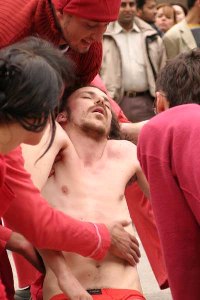 Bologna: Rite of the Opposote Forces ( from Paradise Now )
still nomadic
At this point the Living has about 30 active members. We still have contacts with Europe and Italy, doing tours and intensive workshops in this period. Once again without a house, the Living relies friends who try to theaters and spaces of New York, and producers in Italy who could organize the work. Yet with the many difficulties for the company and its individual members who have struggled to stay afloat, this period has produced significant events such as Utopia , Capital Changes , Anarchy , the revival of Mysteries and Smaller Pieces (1964), and our important work against the death penalty, Not In My Name .
 Bologna: The Pest
 Senza dubbio nessuno, osservando una delle nostre prove comprenderebbe immediatamente il processo poiché apparentemente cinque o sei o più voci dirigono come un comitato. Nel Living ciascuno può dare una nota critica a un altro attore: un processo difficile e talvolta frustrante eppure uno si sente parte del processo di gruppo e qui il Living porta a termine una certa prassi della sua filosofia anarchico-pacifista. Questa processo conta anche quando uno si chiede: come si entra nel Living? Senza audizioni formali, per lavorare Living with you just to be with the Living. Like any community, the process is organic, depending on the time and place, circumstances and the needs of a production. One has only to visit us. Often members of the Living are scattered here and there. Survive as artists in New York or Europe is an awful and work with the Living together involves a lot of sacrifice. But this difficulty producing a fertile work: there are many theater groups born Living, or members of companies that have parallels. We are all filmmakers, writers, poets, musicians, choreographers, producers and activists committed to work even outside the Living, which is well fed and made richer by this work and in turn take their sustenance from the Living. Here in Italy there are few cities or centers that have not hosted a workshop of the Living Theatre or a performance. Sometimes we hear, "What the Living Theatre?" - Because from Naples, Rome and Bologna there was a continuing presence of members of the Living, which created and maintained 'cells groups'. And these same groups have repeatedly broken his arm and tied them to the Living to remain independent and pursue their own way.
From 1999 to 2004 was the Living found a home here in Italy, the Centro Living Europa, Rocchetta Ligure (AL). The successes and problems of this period are documented in the film actor of Livng Dirk Szuszies Resist and you can refer to this period as a link with several articles (see: http://garyliving.blogspot.com/). In short, we create resistance, the partisan struggle against fascism Resist Now, presented at the G8 in Genoa, 'Love and Politics', with J. Malina and H. Reznikov and Enigmas, based on a recent texts by Julian Beck. The work continued in New York with The Water Play, Resist Now (American version), Quality of Life Crimes, and The Code Orange Cantata, for (against) the Republican National Convention (2004). We continue to make tours to Europe and also in Lebanon. I have also re-created the Seven Meditations on Political Sadomasochism (1972) The Living and I wrote and produced other new productions Siddhartha, the smile of the River (Da Hesse), and Joanna the Mariposita (based on the life of Joan of Arc ) and all under the auspices of the Living.
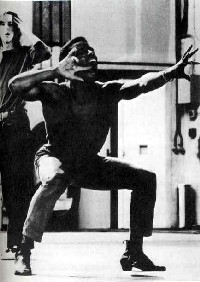 Rufus Collins in Mysteries, circa1964
 start all
Today once again Living is recreating itself. Lost his seat in Italy and Rocchetta embroiled in legal difficulties, burocratiche e finanziarie per l’apertura di un nuovo teatro a Manhattan, il Living, in questa ricorrenza per il 20° anniversario della morte di Julian Beck sembra stia ricominciando di nuovo! Così, dove siamo adesso? Tornando alle parole di Julian, la domanda rimane sempre: perché vai a teatro? E se poi la nostra risposta è affermativa, che si, dobbiamo andare a teatro, allora quale teatro, e dove?
L’unico teatro possibile è il teatro di emergenza
Il libro di Julian Life of the Theatre si lascia leggere in maniera più efficace come manuale personale per il suo teatro di emergenza. Là troviamo, come nel suo ultimo libro e testamento theandric art, two chests full of absolute and essential texts, ideas, suggestions and tips for artists and for the people in struggle for political theater. How can an artist of today do not direct their energies to the creation of works that speak of the fundamental crisis that we face in this time of emergency? The war continues, the impending ecological disaster, the economies made enormous wealth and privilege as opposed to unbearable poverty and famine, a culture whose heart is completely broken and it feeds only its own corruption. Even the voice of Julian, which still echo, we experience the only possible antidote to this end: hope. The function of theater today, its role in life, can only be achieved if it is committed to undermining the culture antithetically opposed to hope. 'How can we make a theater that is worth the lives of its viewers,' asked Julian. We show and as Judith says, seeking to unify the divided aspects of life, which seems impossible to unify: family, political, social, religious, spiritual, sexual, psychological, artistic and economic-in and throughout daily life. If the traditional theater actor waiting in the wings is a person, and only goes down as the stage becomes' aware of its great art ', that becomes an' other person, what we want instead, and we find it especially Julian Beck, is this possibility of total theater that meets a total life. One is an inseparable part is always on-there are scenes in which to hide behind in life. Living: Life is the event and the event is Living (living).
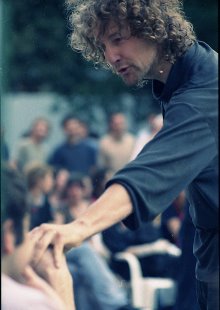 Bologna: Gary Brackett in the ritual, I-Thou,
 Site of the Living Theatre: http://www.livingtheatre.org


0 comments:
Post a Comment